
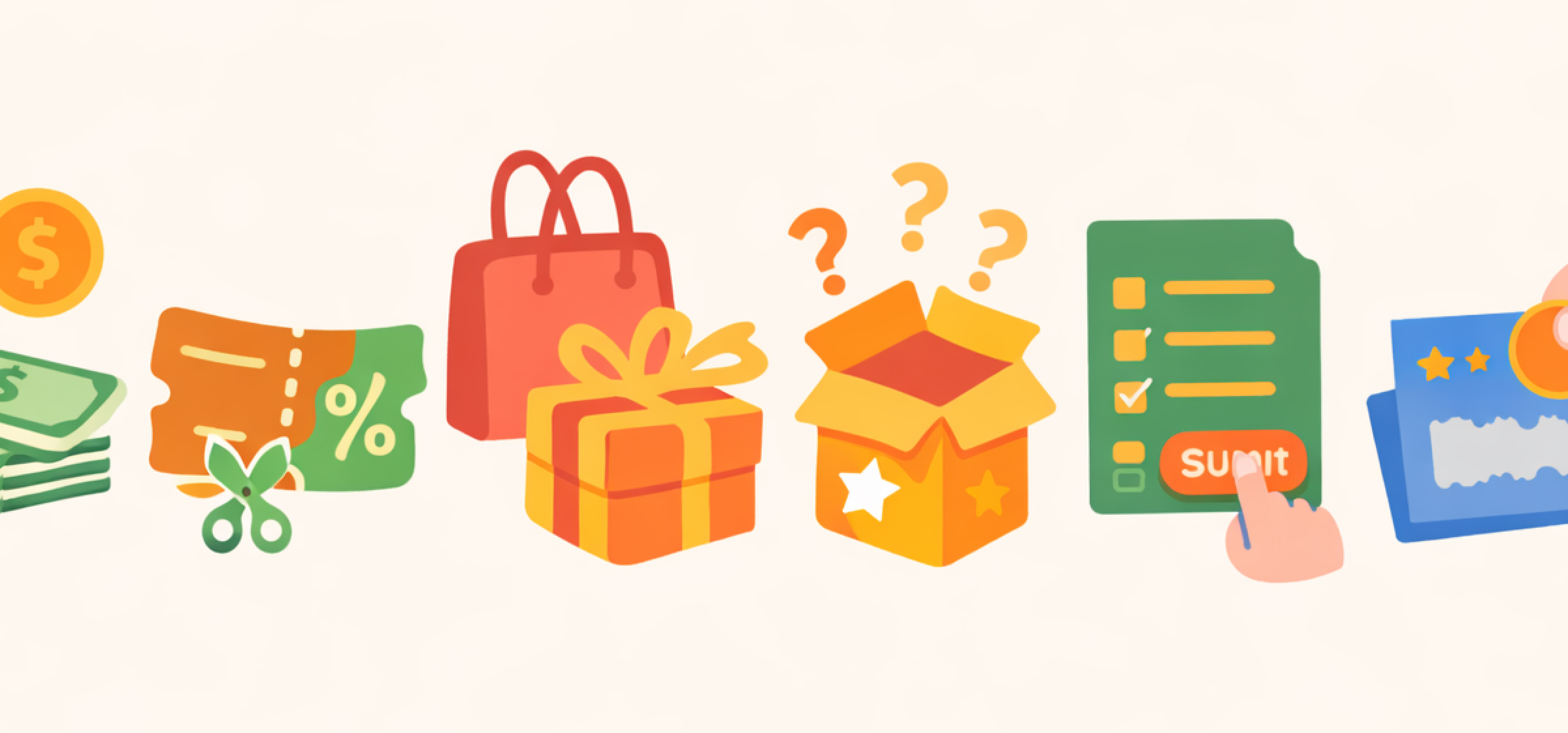
In Malaysia, consumer promotions are especially popular during high-spend periods like Chinese New Year, Hari Raya, and year-end sales — but increasingly, brands are running them year-round to stay competitive in a crowded market.
After working with brands across FMCG, electronics, and retail sectors, one consistent pattern always stands out: promotions are no longer just seasonal tactics. They have become a core part of always-on marketing strategies, especially for brands that rely on retail movement and distributor networks.
According to NielsenIQ, promotions remain one of the top purchase drivers for consumers in Southeast Asia, with price-sensitive shoppers actively seeking deals before committing to a brand. The challenge most brands face isn’t whether to run a promotion — it’s figuring out which type of contest to run, and how to manage it properly so that rewards reach the right people, on time.
This guide will break down the 6 most common types of consumer promotions you can run in Malaysia, how each one works, and how to choose the right mechanic for your next campaign.
A consumer promotion is a short-term marketing activity designed to encourage customers to take a specific action — usually to make a purchase, try a new product, or engage with a brand.
In practice, this often means:
The incentive could be a cash rebate, a gift, a prize, or a voucher — but the goal is always the same: give the customer a clear reason to act now.
According to Shopify, a sales promotion typically involves offering a discount or incentive to drive immediate action. It’s also important to distinguish between:
In Malaysia, consumer promotions are heavily influenced by retail behaviour — in-store purchases, QR code scans, and receipt submissions are the most common entry methods. This is why most campaigns today are built around proof-of-purchase mechanics rather than purely digital engagement.
Trade promotions → Target distributors, retailers, dealers
Consumer promotions → Target end customers directly
In Malaysia, consumer promotions are heavily influenced by retail behaviour — in-store purchases, QR code scans, and receipt submissions are the most common entry methods. This is why most campaigns today are built around proof-of-purchase mechanics rather than purely digital engagement.
A rebate is a partial refund given to a customer after they make a qualifying purchase. Unlike a discount — which reduces the price upfront — a rebate is claimed after the transaction is completed, usually by submitting proof of purchase such as a receipt or invoice.
According to Investopedia, rebates are “widely used in marketing to encourage purchases” and serve as a powerful tool because they attract buyers without permanently reducing a product’s listed price.¹
In Malaysia, rebate campaigns are especially popular among electronics, appliances, and FMCG brands. A customer buys a product, submits their receipt via a portal, and receives a cash rebate or e-wallet credit (Touch ‘n Go, GrabPay) within a set number of days.
Best for: Electronics, appliances, FMCG brands
Voucher redemption campaigns reward customers who take a qualifying action — a purchase, a referral, or a product registration — with a voucher they can use for future transactions. The voucher could be a discount code, an e-wallet credit, or a physical redemption slip.
This mechanic works well for brands that want to drive repeat purchases and build loyalty, since the reward encourages the customer to come back.
Best for: Loyalty programmes, onboarding campaigns, referral incentives
A free gift with purchase (GWP) promotion gives customers a complimentary item when they buy a specific product or spend above a set threshold. The gift could be physical (a tote bag, a travel kit) or digital (an e-voucher, a premium app subscription).
This mechanic is particularly effective for FMCG and personal care brands because it adds perceived value to the purchase without reducing the product’s price.
Best for: FMCG, personal care, retail promotions
A lucky draw is a chance-based promotion where participants enter by completing a qualifying action — making a purchase, registering a product, or submitting a form — and winners are selected randomly on a draw date.
Lucky draws create excitement and urgency, and are a staple of festive campaigns in Malaysia (Chinese New Year, Hari Raya, year-end). They work well for driving product trials and generating brand buzz.
According to Shopify, giveaways and draw-based promotions are among the most effective ways to “attract potential customers and delight existing ones.”²
Best for: Product launches, festive campaigns, brand activations
A submit-to-win contest asks participants to submit something — a photo, an answer to a question, a creative entry — in exchange for a chance to win a prize. Unlike a lucky draw (which is pure chance), submit-to-win campaigns involve a judging or screening element.
This makes them ideal for brands that want higher engagement and user-generated content, as participants invest more effort into their entries.
Best for: Photo contests, essay competitions, social campaigns
Scratch card promotions give customers a physical or digital card that reveals an instant prize when scratched. The mechanic delivers immediate gratification — customers know right away whether they’ve won, which drives excitement at the point of purchase.
Digital scratch cards are increasingly popular in Malaysia, where customers scratch via a mobile portal after submitting their purchase proof. AI verification ensures only valid submissions unlock the scratch mechanic.
Best for: Retail promotions, in-pack mechanics, point-of-sale campaigns
With six promotion mechanics on the table, how do you decide which one to run? The answer comes down to three things: your campaign goal, your product type, and your budget.
Different promotions drive different outcomes. If you’re clear on what you want to achieve, the right mechanic often becomes obvious:
| Goal | Best Mechanic |
|---|---|
| Drive immediate sales | Rebate / Cashback |
| Generate brand buzz and excitement | Lucky Draw |
| Reward loyal customers | Voucher Redemption |
| Increase purchase value | Free Gift with Purchase |
| Collect user-generated content | Submit-to-Win |
| Drive point-of-sale conversion | Scratch Card |
Not every promotion works for every category. Here’s a quick guide for Malaysian brands:
FMCG & F&B brands (Drinho, Hershey’s, Dutch Lady) tend to work best with lucky draws, scratch cards, and free gift mechanics — because their purchase price is low and the reward needs to feel proportionally exciting.
Electronics & appliance brands (Panasonic, Philips, Samsung) are better suited for rebate and cashback campaigns — the higher price point means a cash-back reward feels meaningful and worth the effort of submitting a claim.
Retail & lifestyle brands lean towards voucher redemption and free gift with purchase — rewards that keep customers in the brand ecosystem and drive repeat visits.
Some mechanics are simpler to manage than others:
According to Shopify, the best promotions are those that balance “short-term sales lift with long-term brand value”. Meaning the incentive should feel generous to the customer without permanently devaluing your product.
A good rule of thumb for Malaysian brands is to start with the mechanic your target customer already expects in your category, then layer in the one that best fits your campaign goal. For example, an FMCG brand running a festive campaign might combine a lucky draw (for excitement) with a gift with purchase (for immediate gratification).
To run a consumer promotion in Malaysia, brands need to get the legal, operational, and platform requirements right before launch. Here’s what to prepare:
Lucky draws, contests, and prize-based mechanics are regulated under the Common Gaming Houses Act 1953 and the Trade Descriptions Act 2011, both enforced by the Ministry of Domestic Trade and Cost of Living (KPDN).
Key compliance requirements include:
Important: Always consult a qualified legal advisor for the most up-to-date compliance requirements before launching a promotion campaign in Malaysia.
Beyond compliance, you need a way to collect, verify, and process claims at scale. Most brands in Malaysia run their promotions through a dedicated campaign portal. They often use a built-in-house platform or engage with a third-party platform like ClaimNow.
A good campaign platform should be able to handle:
Most brands underestimate how long it takes to set up a promotion properly. Here’s a realistic timeline:
| Phase | Typical Duration |
|---|---|
| Campaign planning & mechanic design | 1–2 weeks |
| Portal setup & branding | 3–5 working days |
| Legal review & T&C preparation | 1–2 weeks |
| Soft launch / testing | 2–3 days |
| Campaign live period | 2–8 weeks (varies) |
| Claims processing & payout | Ongoing during & after campaign |
| Post-campaign report | 1–2 weeks after close |
The full process from brief to launch typically takes 3–4 weeks minimum. Brands that try to rush this often face compliance issues, verification backlogs, or delayed payouts — all of which hurt participant experience and brand reputation.
Consumer promotions are one of the most powerful tools in a Malaysian brand’s marketing toolkit — but only when they’re run correctly. A lucky draw that’s poorly managed leads to frustrated participants and unanswered claim queries. A rebate campaign without proper verification bleeds budget to fraudulent claims. A scratch card mechanic that takes days to process kills the instant gratification it was designed to create.
The good news is that the mechanics themselves are well-proven. Malaysian consumers respond enthusiastically to well-run promotions — whether it’s a festive lucky draw, a cashback offer on their new appliance, or a scratch-and-win at their favourite supermarket. The key is choosing the right mechanic for your goal, setting it up compliantly, and making sure every participant gets a smooth, fast, and fair experience.okie this
As Shopify puts it, the best promotions balance “short-term sales lift with long-term brand value” — meaning the way you run your promotion says as much about your brand as the prize itself.
© 2026 Red Ant Technology Sdn Bhd (200901021613). All Rights Reserved